Technical Session on Climate Change Studies and Equipment Demonstration
- March 25, 2026
- Rjt664
- 0
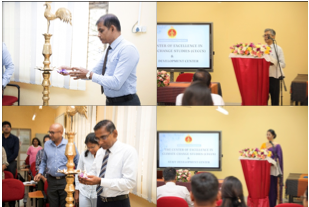
A Technical Session on Climate Change Studies, followed by an equipment demonstration, was successfully held on 23rd March 2026 at the Staff Development Centre of Rajarata University of Sri Lanka. The event was coordinated by Prof. Nadeeka Kumari, with support from Prof. Lalith Senarathne, Director of the Staff Development Centre (SDC), and in collaboration with the Centre for Excellence in Climate Change Studies (CECCS). The programme aimed to provide a platform to showcase ongoing research and to foster future collaborations in climate change studies.
The session commenced with the traditional lighting of the oil lamp, followed by the welcome address delivered by Prof. N.S. Abeysingha. The Vice Chancellor, Prof. Bandula Jayathilake, in his address, emphasized the importance of strengthening the Centre by establishing it in a dedicated location and highlighted the need for enhanced interdisciplinary collaboration in addressing climate change challenges.
The technical session featured a series of insightful presentations by university researchers and academics. Prof. N.S. Abeysingha presented on “Shifts in Rainfall Pattern in Sri Lanka: Implications for Agricultural Adaptation to Climate Change.” Mr. N.M.K.C. Premarathna discussed “Climate Information and Utilisation,” while Mr. Amila Lankapura explored “The Third Pillar of Climate Action: Evolution and Future Research Directions in Loss and Damage.” Prof. Manjula Ranagalage delivered a presentation on “Application of Geo-informatics for Climate Change Studies.” Mr. Janith Madusanka (online) presented “The Role of Accountants in Climate Change Mitigation: A Qualitative Study from Sri Lanka.” Dr. Chathuranga Thotawatthage shared his work on “Implementation of a Low-Cost Homemade Antenna for Satellite Weather Information Receiving.” Dr. Lahiru Jayasooriya provided insights into “Sri Lanka’s Sustainable Energy Future: Insights from Climate, Land, Energy, Water Systems (CLEWs) Modelling.” In addition, Mr. Thilanka M. Siriwardana presented “The History of Climate Change as Evidenced by Land Snails.” Collectively, these presentations highlighted the multidisciplinary nature of climate change research undertaken at the university.
An engaging discussion session followed, moderated by Prof. N.S. Abeysingha, focusing on improving the communication of research findings to policymakers and local communities. Participants underscored the importance of disseminating research outcomes in local languages to enhance public understanding and policy impact. The session also explored potential areas for future collaboration, with suggestions to organize proposal development workshops to support grant applications. The Staff Development Centre expressed its willingness to continue supporting such initiatives in partnership with CECCS.
The programme concluded with a demonstration of newly acquired equipment, including an Automatic Weather Station, Mini Infiltrometer, Hydraulic Conductivity Meter, and Flow Meter, highlighting the Centre’s growing capacity for advanced climate research.
Overall, the event served as a valuable platform for knowledge sharing, collaboration, and strengthening institutional efforts towards addressing climate change.